Viramos
A multi-role operational SaaS for sailing championships—rebuilt from a no-code MVP into a role-based, permission-driven platform serving 5 countries across Latin America.
Role
Product Designer
Timeline
11 months, 2024–2025
Team
Founder, Sailing Advisor, Product Owner, Scrum Master (part-time), Engineers, QC, Designer (me)
 Figma
Figma Figjam
 GPT
GPT Shadcn
 VS Code
 Github
 Next.js
 Bubble
 Notion
 Google Workspace
 Slack
SlackContext
Four distinct role domains—clubs, organizers, judges, and sailors—each with overlapping permissions and no shared operational backbone.
The no-code MVP validated the market; the architecture couldn't follow.
My Role
System architecture
Owned the platform architecture alongside the PO and tech lead—from championship lifecycle model and domain design to a permission-aware structure built around four overlapping operational roles.
Workflow re-architecture
Restructured a multi-committee operational system into role-aware, reusable modules—each with distinct org-side and competitor-facing interactions, consistent across any championship category or regulatory format.
Role & permission model
Designed a permission system defining explicit authority, visibility rules, and decision boundaries at the action level—enabling strict role separation for large championships and flexible overlap for smaller ones.
Design system—Figma to production
Built a shadcn-aligned design system in Figma and contributed directly to the production codebase, aligning layout, components, and visual behavior with design intent where implementation diverged.
Field research & on-site immersion
Led research at SIVI—Latin America's largest sailing championship—and multiple live events, surfacing mobile-first constraints, regulatory workflows, and role dynamics that directly reshaped the architecture.
Product definition
Defined product features alongside the PO through direct field observation—the check-in/check-out system, for instance, emerged from watching actual championship operations in real-time.
System architecture
Owned the platform architecture alongside the PO and tech lead—from championship lifecycle model and domain design to a permission-aware structure built around four overlapping operational roles.
Workflow re-architecture
Restructured a multi-committee operational system into role-aware, reusable modules—each with distinct org-side and competitor-facing interactions, consistent across any championship category or regulatory format.
Role & permission model
Designed a permission system defining explicit authority, visibility rules, and decision boundaries at the action level—enabling strict role separation for large championships and flexible overlap for smaller ones.
Design system—Figma to production
Built a shadcn-aligned design system in Figma and contributed directly to the production codebase, aligning layout, components, and visual behavior with design intent where implementation diverged.
Field research & on-site immersion
Led research at SIVI—Latin America's largest sailing championship—and multiple live events, surfacing mobile-first constraints, regulatory workflows, and role dynamics that directly reshaped the architecture.
Product definition
Defined product features alongside the PO through direct field observation—the check-in/check-out system, for instance, emerged from watching actual championship operations in real-time.
Solution
We rebuilt Viramos in Next.js with a system-first approach—replacing workarounds with a permission-aware operational backbone that scales across any championship format.
Clubs
Permission-based championship management
Modular architecture enables consistent setup across championship categories and regulatory formats.
- Championship structure aligned with regulatory requirements
- Action-level permission assignment per invited member
- Centralized multi-scope publication control
Committees
Formalized regulatory workflows
Traceable, structured interactions built around real-world procedures and role boundaries.
- Configurable deadlines with submission windows
- Committee-assigned resolutions with structured decision documentation
- Traceable decisions with role-controlled visibility
Sailors
Dock-side real-time access
Mobile-first interface designed for real-time usage during competition.
- Simplified access to results, notices, and updates
- Full competition request access from the field
- Low navigation depth for high-attention, on-the-move usage
Impact
Viramos operates today as the digital backbone for competitive sailing championships in Latin America.
2025 metrics
See also
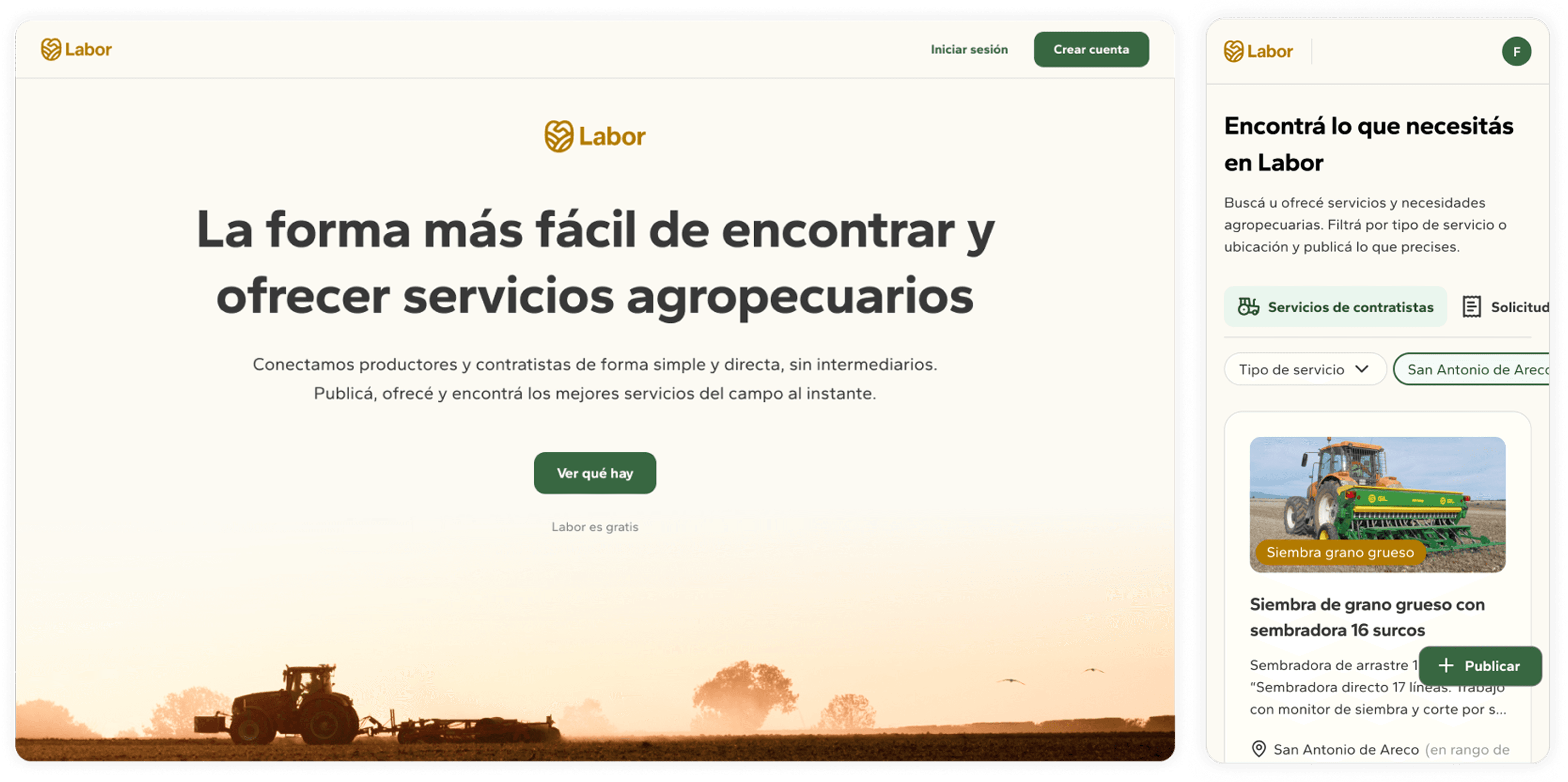
Labor
2026
A 0→1 agriculture marketplace shipped to production in 2 months. Built on Next.js, deployed on Vercel with Vercel Blob, Supabase, Clerk auth, and Google Maps.

Theo AI
2025
Rapid product exploration at an early-stage legal AI startup: prompt-engineered research tooling and multi-format design for high-friction enterprise users.