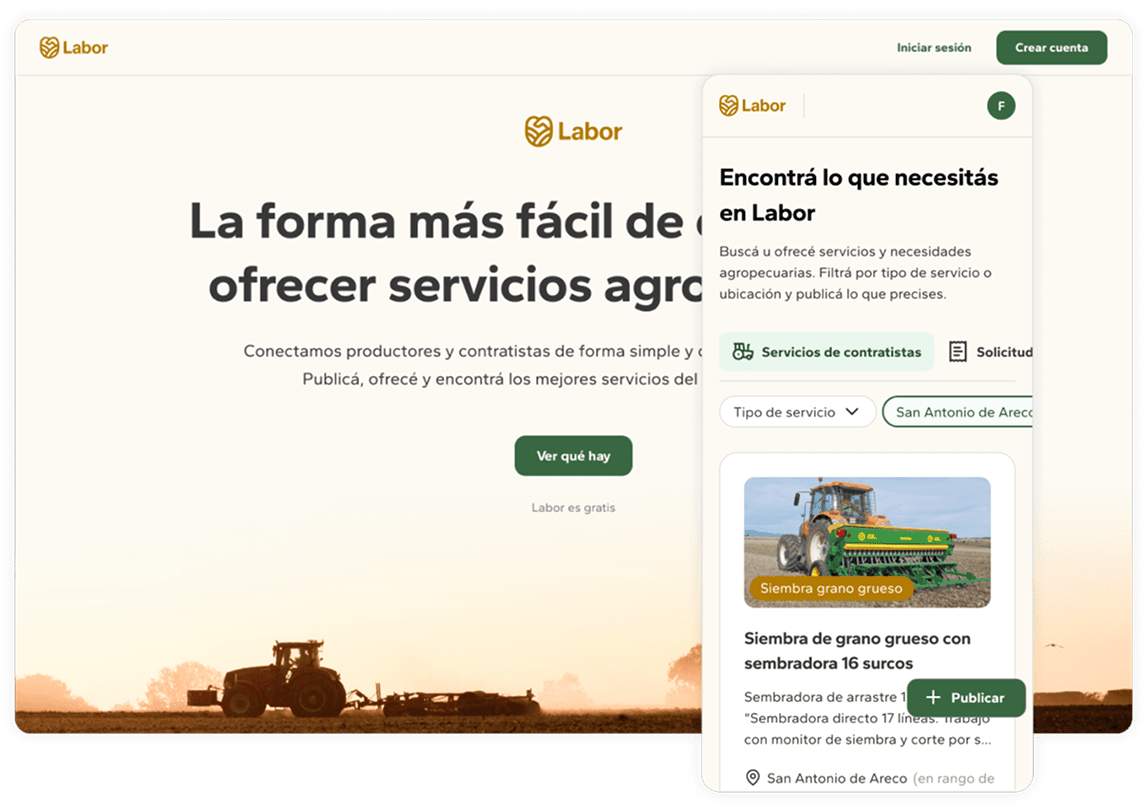
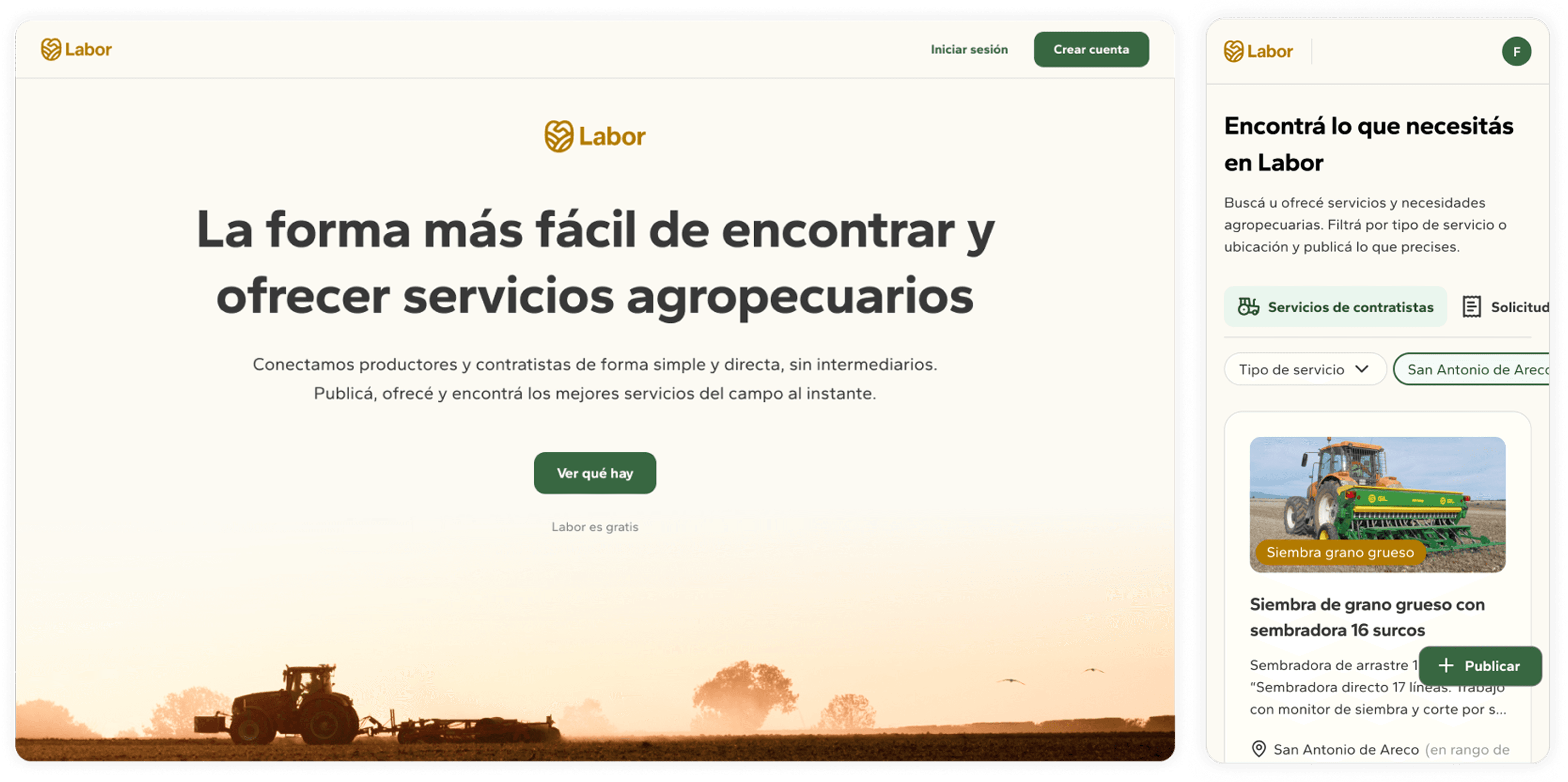
Labor
A 0→1 agriculture marketplace shipped to production in 2 months. Built on Next.js, deployed on Vercel with Vercel Blob, Supabase, Clerk auth, and Google Maps.
Role
Product Designer / Design Engineer
Timeline
2 months, 2025–2026
Team
Founders, Product Owner, Engineering Advisor (for weekly consulting), Designer (me)
 Cursor
 Github
 Vercel
 Next.js
 Claude
 GPT
GPT FigmaClerk
 Supabase
 Notion
 Google Workspace
 Slack
SlackContext
Agricultural services in Argentina run on informal networks—no structured way to connect producers and contractors without intermediaries.
Tight budget, 2 months, two people, one goal: validate the product core.
My Role
Implementation—Vibecoded
Built 50% of all production features directly in code, including authentication flows, publishing forms, geo-filtered search, and third-party integrations.
UI system
All screens and UI patterns designed in Figma, aligned with shadcn components used in production, ensuring full parity between design and implementation.
Product architecture
Defined the core domain model, user flows, and core loop, structuring the entire platform around a single publish-discover-contact cycle.
Data model design
Designed the database schema: table structure, entity relationships, and data architecture aligned with the platform's service taxonomy and user flows.
Service taxonomy
Designed the category logic and information hierarchy for filtering services by type and geolocation—results pre-filtered by user location for immediate relevance.
AI-assisted workflow
Used AI to evaluate stack decisions and accelerate iteration—including identifying Vercel Blob as the asset pipeline solution.
Implementation—Vibecoded
Built 50% of all production features directly in code, including authentication flows, publishing forms, geo-filtered search, and third-party integrations.
UI system
All screens and UI patterns designed in Figma, aligned with shadcn components used in production, ensuring full parity between design and implementation.
Product architecture
Defined the core domain model, user flows, and core loop, structuring the entire platform around a single publish-discover-contact cycle.
Data model design
Designed the database schema: table structure, entity relationships, and data architecture aligned with the platform's service taxonomy and user flows.
Service taxonomy
Designed the category logic and information hierarchy for filtering services by type and geolocation—results pre-filtered by user location for immediate relevance.
AI-assisted workflow
Used AI to evaluate stack decisions and accelerate iteration—including identifying Vercel Blob as the asset pipeline solution.
Solution
A fluid participation MVP built around one core loop: Publish → Discover → Contact → Review
Validation metrics defined for the client to measure: listing creation, contact initiation, and return visits.
Unified publishing
A guided flow that adapts to the user's intent — whether publishing a service offering or searching for one — from a single shared entry point.
- Single shared home as entry point
- Role defined contextually, not pre-selected
- Conditional fields with trust-oriented UX guidance
Location & service-driven discovery
A relevance-first architecture anchored in user location, ensuring results are immediately actionable for people working in specific regions.
- Pre-filtered by user context
- Hierarchical service taxonomy
- Direct contact externalized to validate real interaction
Lightweight trust loop
A set of lightweight signals that help users make confident decisions without requiring platform-mediated guarantees.
- Service imagery (up to 3 photos)
- Guided service descriptions
- Peer reviews surfaced on profile
See also
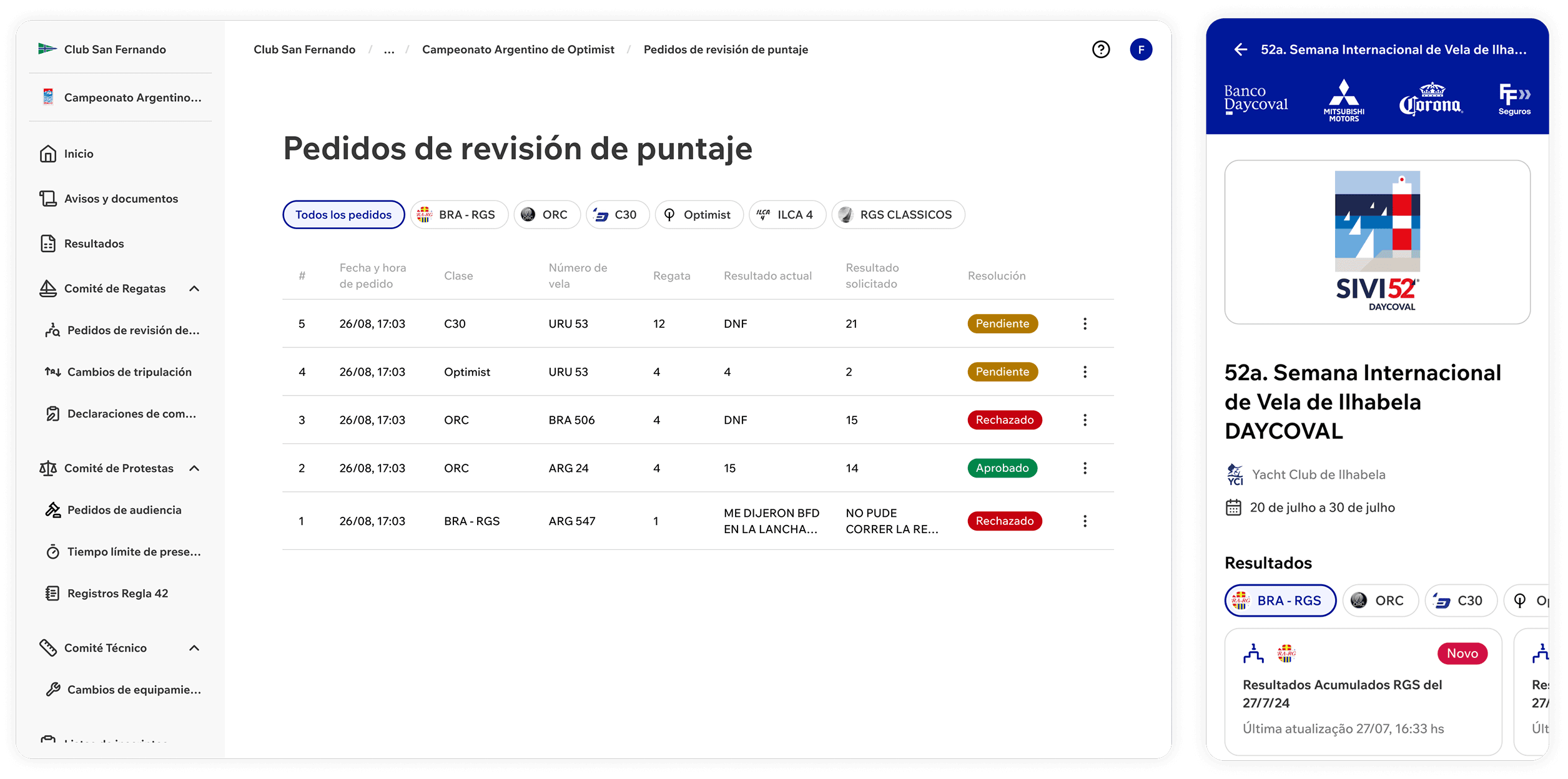
Viramos
2024 - 2025
A multi-role operational SaaS — rebuilt from a no-code MVP into a role-based, permission-driven platform serving 5 countries across Latin America.
Theo AI
2025
Rapid product exploration at an early-stage legal AI startup: prompt-engineered research tooling and multi-format design for high-friction enterprise users.